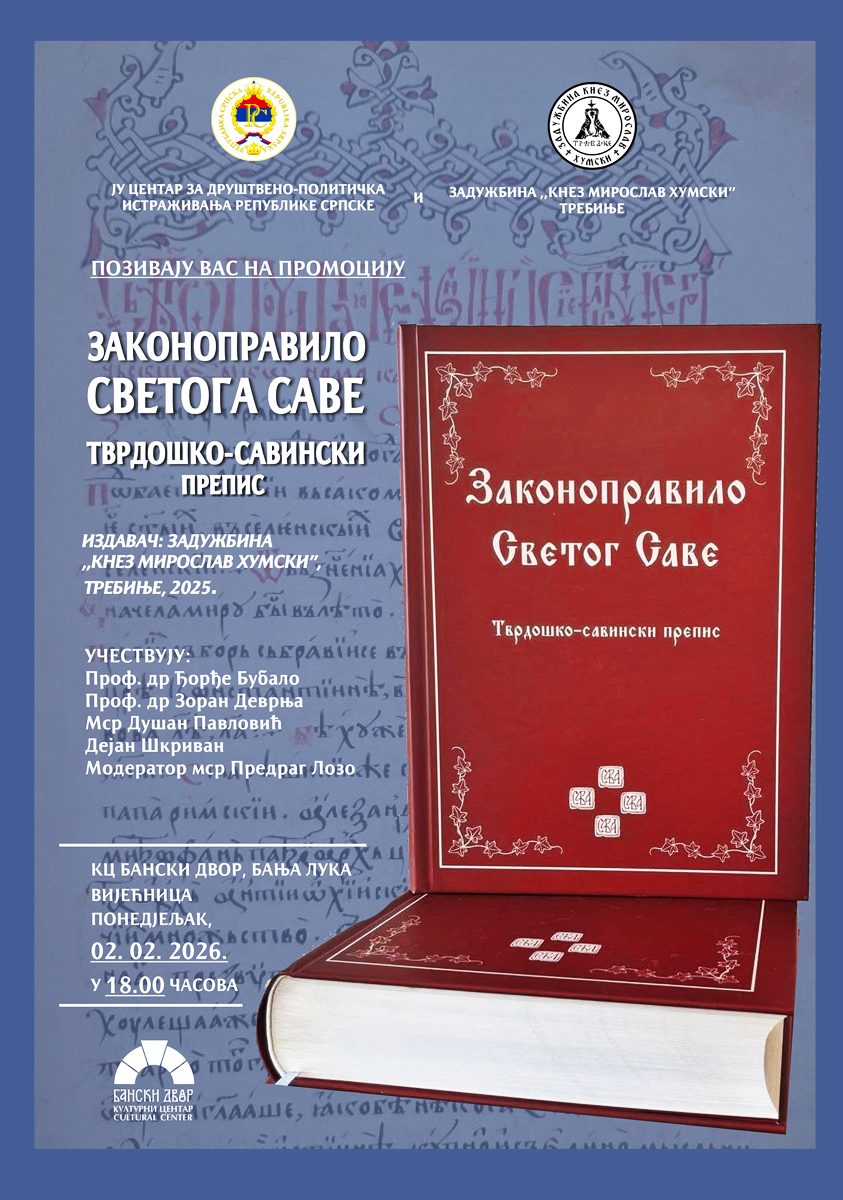
On the occasion of the 850th anniversary of the birth of Rastko Nemanjić — Saint Sava, the Public Institution Centre for Socio-Political Research of the Republika Srpska is organizing the scientific and professional symposium “Saint Sava and the Nomocanon: Culture, State-Building, Geopolitics, and Civilization,” as well as the ceremonial promotion of the edition Saint Sava’s Nomocanon — the Tvrdoš–Savin transcript.
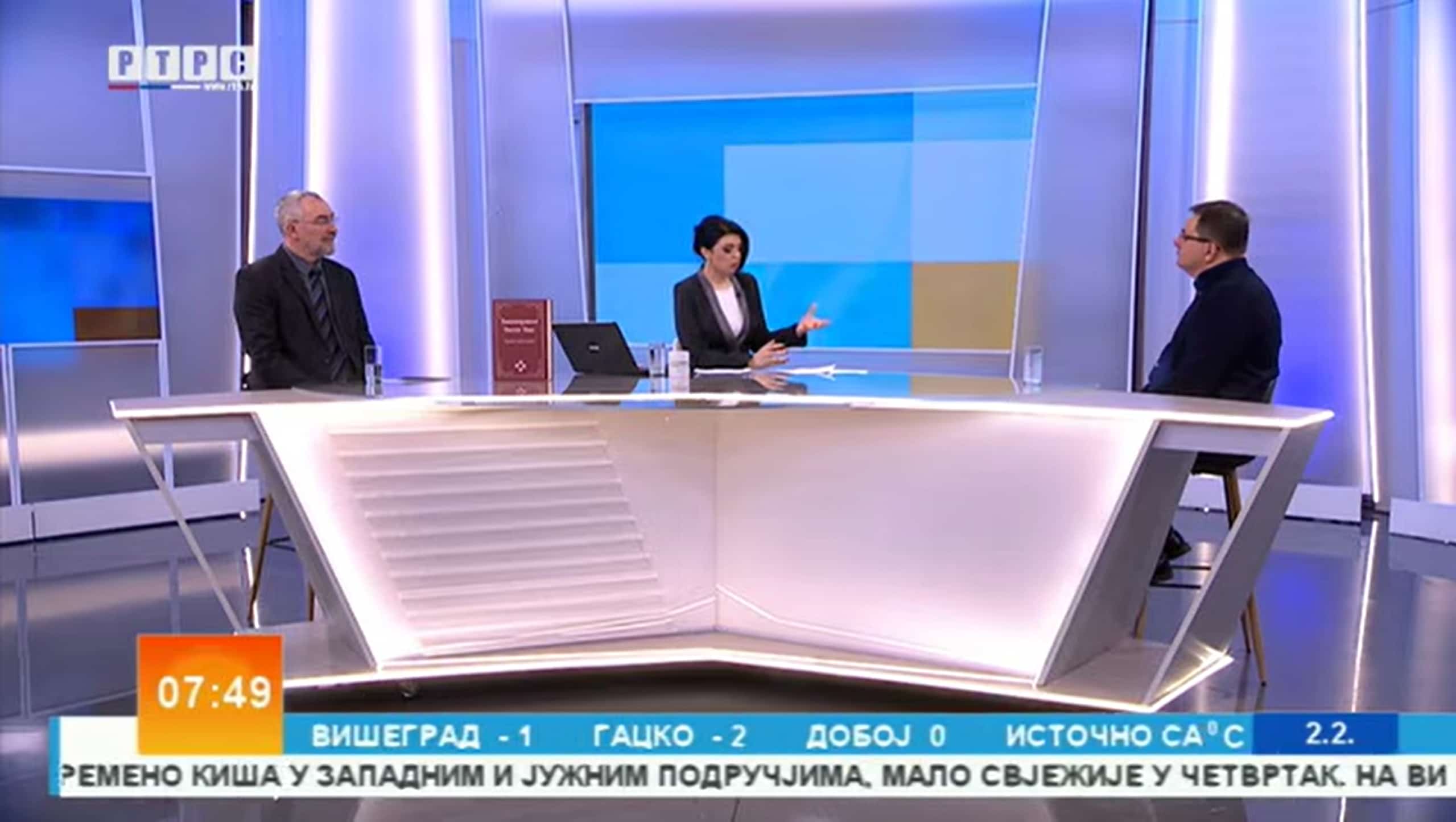
On that occasion, in a morning news programme, Dušan Pavlović—Director of the Centre for Socio-Political Research of the Republika Srpska—and Prof. Dr. Zoran Čvorović, professor at the Faculty of Law of the University of Kragujevac, spoke about the significance of the Nomocanon and the figure of Saint Sava.
Dušan Pavlović emphasized that Saint Sava brought the Serbian people and state into the circle of the Christian and European civilization of the time precisely through the Nomocanon, stressing that it was not only an ecclesiastical document, but also a state-legal one. As he noted, the Nomocanon established a model of “symphony” in relations between the state and the Church, providing Serbia in the 13th century with the foundations of the rule of law, an orderly society, and a unified legal and linguistic system.
“The Nomocanon is a civilizational, cultural, state-legal, geopolitical and identity document whose significance cannot be explained simply. It is evidence of our centuries-long continuity of statehood and legal culture,” Pavlović emphasized.
Professor Zoran Čvorović pointed out that Saint Sava understood that there can be no lasting state without a firm legal foundation, and that the Nomocanon functioned for centuries as the constitution, legal code, and moral compass of the Serbian people. He recalled that it is a nomocanon — a collection of church canons and the most developed Byzantine legal regulations of the time, which, in terms of legal-technical sophistication, were ahead of the contemporary Western European legal practice.
It was particularly emphasized that Saint Sava adapted legal norms to Serbian circumstances, creating a Serbian legal language and carefully selecting commentaries that corresponded to the Serbian spiritual and state context. According to Čvorović, the Nomocanon became “the first major export product of Serbian legal culture,” adopted not only in Serbia but also in Bulgaria and Russia, where it served for centuries as the foundation of state and ecclesiastical law.
The participants also underscored the exceptionally modern character of the Nomocanon, noting that it clearly defines norms for the protection of the most socially vulnerable, children, the elderly and the infirm, as well as provisions regulating conflicts of interest and responsible management of property — topics that remain relevant in contemporary societies.
Pavlović emphasized that the symposium was organized precisely in order to reassess, within today’s geopolitical and identity context, the significance of Saint Sava and the Nomocanon, and to recall the deep roots of the Serbian tradition of state-building and legal culture.
The scientific and professional symposium begins at 9:00 a.m. in the Government of the Republika Srpska building, while the ceremonial promotion of the edition “Saint Sava’s Nomocanon – the Tvrdoš–Savin transcript” will be held at 6:00 p.m. at the “Banski Dvor” Cultural Centre in Banja Luka. All presentations and discussions will be recorded and made available to the public through the organizers’ media outlets and social media channels.