


Text and photographs courtesy of Radio Srbac
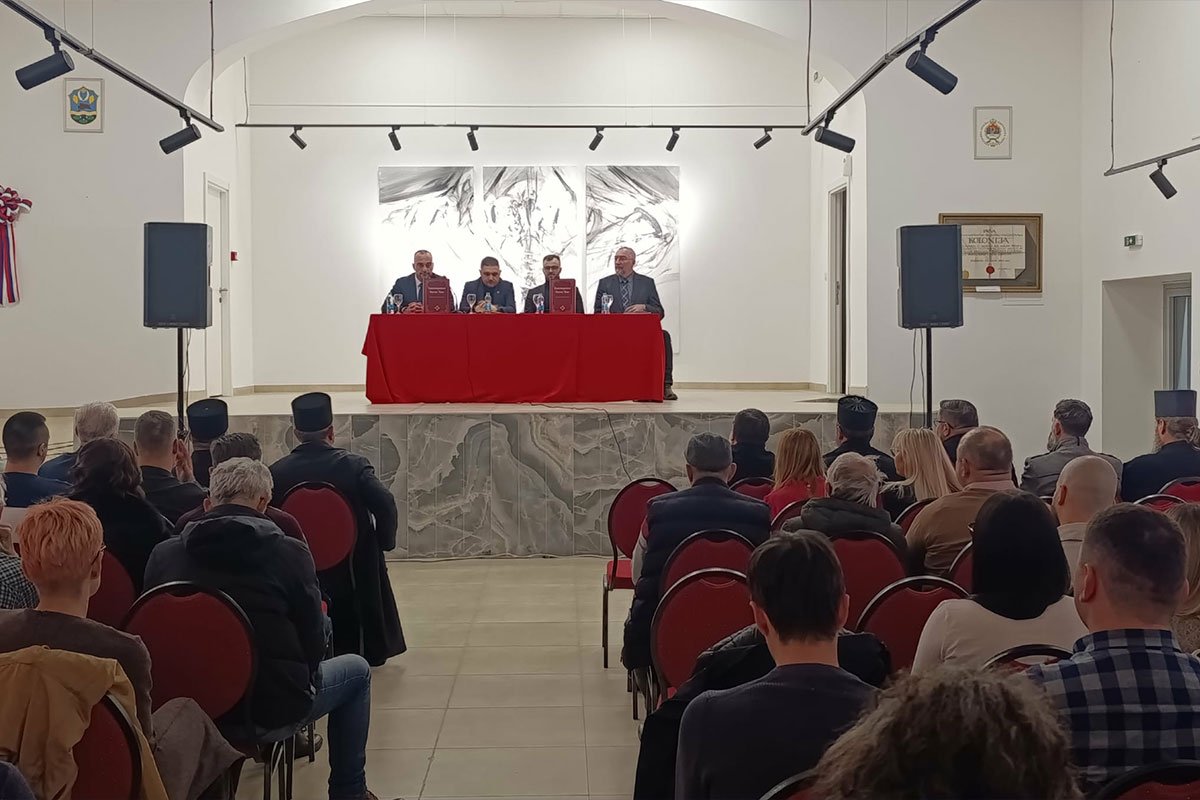
Within the activities marking the 850th anniversary of the birth of Rastko Nemanjić—Saint Sava, on 3 February a facsimile edition of the book The Nomocanon of Saint Sava – The Tvrdoš–Sava Manuscript was presented at the “Rajko Petković” City Gallery in Srbac. The edition was published by the Foundation “Knez Miroslav Humski” from Trebinje. The event was organized by the Srbac National Library.
Speaking about the book and the importance of Saint Sava for the entire Orthodox world were historians Predrag Lozo and Dejan Došlić, as well as Dušan Pavlović, Director of the Centre for Socio-Political Research of the Republic of Srpska.
This monumental work—one of eleven preserved manuscript copies, which for a time was kept at the Tvrdoš Monastery in Trebinje—stands as a foundation of Serbian statehood and spirituality, a mirror of Serbian history and spiritual heritage, and carries key significance for the historical and cultural continuity of the Serbian people, as well as of other Orthodox peoples.
The audience was first addressed by historian Predrag Lozo, who said that the work is a collection of canonical church law and secular law compiled by Rastko Nemanjić—later a monk and Saint Sava—thereby laying the foundations of Serbian legal statehood, spirituality, and the organization of both church and state. He emphasized that the Nomocanon is a document of crucial importance for the overall system of values by which the Serbian people still function today.
“The edition presented is a facsimile edition of the Nomocanon, published by the Foundation “Knez Miroslav Humski” from Trebinje, and it bears witness to the effort of a generation that possessed the awareness and responsibility to once again highlight the importance of this work. Because of our turbulent history, we do not have the original copy of the Nomocanon from Saint Sava’s time, but the Serbian Orthodox Church, through its monastic and priestly ranks, preserved eleven manuscript copies of this work. This testifies to the perseverance and safeguarding of the Serbian people’s tradition under the most difficult historical circumstances,” Lozo said, adding that even today we still do not have all known editions collected in one place, nor their comprehensive analysis and a translation into contemporary Serbian—something that clearly points to the need for systematic, institutional engagement by the state, since this is one of the foundational documents of Serbian historical existence in these lands.
Dejan Došlić, a historian and senior teaching assistant at the Faculty of Philosophy in Banja Luka, said that Saint Sava’s Nomocanon represents a unique codification of civil law and church canons, based on the Byzantine—i.e., Roman—legal tradition. Došlić noted that Saint Sava introduced that system among the Serbs, and that through Serbian manuscript copies the Nomocanon was later adopted by the Bulgarians, Russians and other Orthodox peoples as well. Its significance has been particularly recognized in Russian scholarship, where from the 19th century to the present day scholars have continuously pointed to the role of the Nomocanon in shaping the legal system of the Russian state.
“Today it is important that we return to studying the Nomocanon, not only as a legal monument, but as a mirror of our relationship to our own tradition. It cannot be interpreted exclusively from a contemporary perspective, but through an understanding of the harmony between secular and ecclesiastical authority—the symphonia of the two powers—on which both statehood and church life rested in the Nemanjić era. That model can still, even today, be a key for reflecting on our Church, our state and our society,” Došlić emphasized.
Dušan Pavlović, Director of the Centre for Socio-Political Research of the Republic of Srpska, also emphasized the importance of the Nomocanon, stressing that it is the most significant document in the Serbian people culture and history after the translation of the New Testament, and that it is a work that shaped the Serbian people’s system of values, mentality and relationship to God, to others, and to life in general.
“At the same time, the Nomocanon represents a state-legal and civilizational continuity of the Serbian people spanning more than eight centuries. Thanks to Saint Sava’s work, the Serbs already in the Middle Ages became part of European civilization, long before some peoples whom we today consider the bearers of contemporary culture. Although much was lost during the centuries-long period of subjugation under Ottoman rule, the Nomocanon endured even then. Later, it also served as a foundation in Karađorđe’s Serbia, as well as in subsequent state forms. That tradition is still visible today in the relationship between the state and the Church across all Serbian lands. When we speak of the Nomocanon, we are speaking about who we are and what we are—about the fact that we have been civilizationally present for almost a thousand years and that from this heritage we can draw strength and guidance for the future historical course of the Serbian people,” Pavlović said.
Slaviša Stojković, Director of the Srbac National Library, expressed his satisfaction that the presentation of such a significant book was held in Srbac, adding that it is necessary to speak about it—especially at a time when our people are facing various crises.
“In these difficult times it is very important for the institutions of the Republic of Srpska to show due regard for our olden works that bestowed statehood. Here, statehood was given in the thirteenth century, which we often forget. We are guided by constitutions from the eighteenth and nineteenth centuries, yet we already had a Constitution in the thirteenth century and rules by which to live. That is why our only true answer to these times of crisis is a culture of remembrance and memory, because in that way we preserve our tradition and our faith,” Stojković said.
Among the many attendees at the event were Mayor Mlađan Dragosavljević, National Assembly of the Republic of Srpska MP Radojica Vidović, members of the Srbac Municipal Assembly, directors of public enterprises and institutions, Hieromonk Ilarion from the Osovica Monastery, Archpriest-Stavrophore Dalibor Đekić from Derventa and clergy from the area of the Municipality of Srbac.
Gallery: