



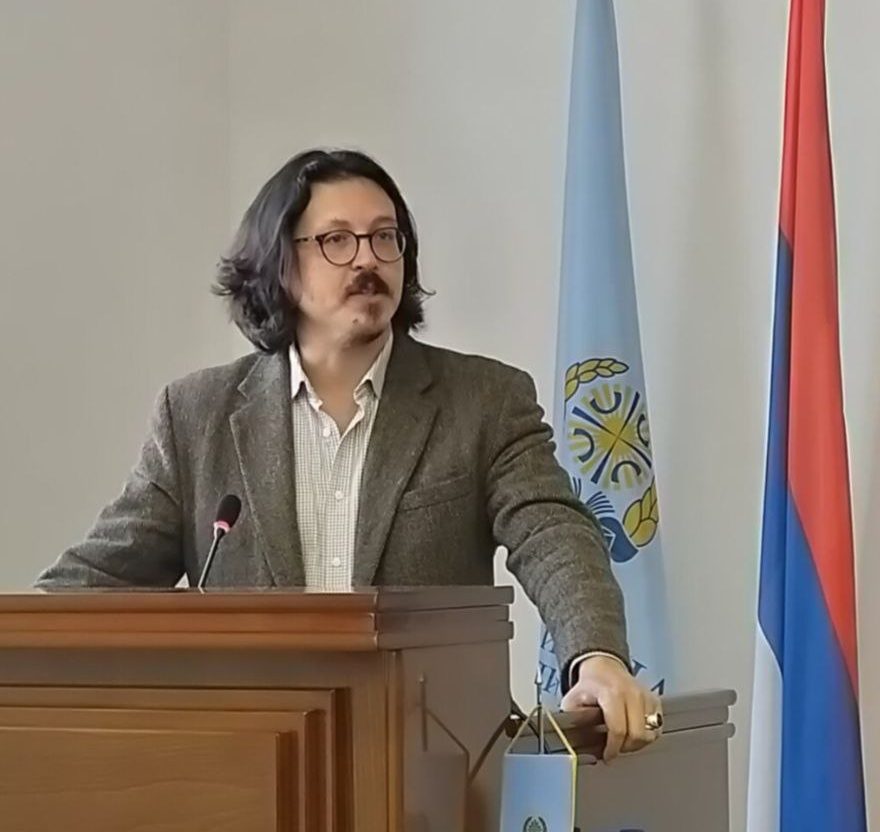
The text is taken from the first issue of the journal “Centar” of the CSPR RS
1. Professor Engels, you are a researcher, lecturer, historian, and an advocate of a particular idea of Europe. How did you manage to balance your research with your convictions?
For me, there is no contradiction between rigorous research and personal convictions—or rather, the coherent consequences that follow from the results of past research. Every historian—whether he admits it or not—approaches the past with a certain worldview and emerges from his research with a certain opinion, sometimes identical to, sometimes different from, his initial assumptions. The important point is intellectual honesty: arguments must be grounded in sources, methods must be transparent, and conclusions must remain falsifiable. My own civilisational convictions are not imposed on the source material; they arise from long-term patterns that emerged across my study of Antiquity, the Middle Ages, and modern Europe. Thus, when I warn about Europe’s decline or advance the need for cultural self-defence, it is not out of ideological passion but out of a historian’s concern for the actual consequences of his studies. In other words, conviction provides the direction, scholarship the testing ground, and the results of the research the practical lessons—and the task of the intellectual is to ensure that all three remain in dialogue rather than in conflict.
2. How do you see divided states within the future construction of Europe?
Europe has always included divided, composite, and pluricultural states. The essential question is not whether a state is internally diverse, but whether its diversity is embedded in a meaningful civilisational framework. A future Europe must avoid two extremes: the atomisation into dozens of micro-states incapable of defending themselves, and the oppressive Brussels centralisation that erases local identity. The only workable model is a patriotic, conservative, civilisational confederation—what I call „Hesperialism“—where subsidiarity is respected, but strategic competences are exercised jointly. In such a structure, divided states can flourish: their internal complexity becomes a microcosm of the European whole rather than a source of permanent instability.
3. Do you believe in the cyclical nature of history?
Yes. Civilisations do follow long structural rhythms: a slow preparation, a period based on transcendence, an antithesis based on materialism, a synthesis in which tradition and reason are combined, and then a slow fading into fossilisation. This is evident in Egypt, ancient China, India, the Greco-Roman world, and many others — and of course also in European civilisation. Obviously, these cycles are not exactly repetitive in content, but they remain strongly comparable in form. The late Roman Republic, for example, offers striking analogies to today’s Western world, as I have shown in my book “On the Path Towards Empire”: demographic decline, institutional paralysis, mass migration, de-sacralisation, globalisation, social polarisation, populism, bread and circuses, moral exhaustion, and finally civil war and Empire. Recognising these patterns does not condemn us to fatalism; rather, it gives us tools to act in order to make the best of historical necessities and to fulfil our potential as well as we can without becoming unrealistic. If history has a cyclical dimension, it is only because human nature itself remains tragically constant.
4. What kind of reception does your research and contemplations receive in Western Europe?
Reactions are, unsurprisingly, divided. In academic circles, my work is generally respected for its comparative methodology and for a series of individual parallels I draw between different past civilisations. But of course, as soon as I speak about the consequences of these studies for the modern West, many colleagues disagree with my conclusions, as they contradict their own, generally linear and progress-centered worldview. As for the broader public, the reception depends largely on ideological orientation. Those who sense that Europe is undergoing a profound civilisational crisis are often relieved to see their intuitions articulated within a historical framework. Others, especially within the progressive mainstream, view any reference to civilisational identity as suspicious or regressive. Yet even critics are slowly forced to acknowledge that the crises I have described—migration, demographic collapse, cultural fragmentation, geopolitical weakness—are now at the centre of European politics. In that sense, reality itself has become my most effective argument, even though those who criticised me 10 years ago and now come to the same conclusions would never admit so or refer to my work.
5. You also come from a divided state. Can you draw parallels between Bosnia and Herzegovina and Belgium?
Belgium and Bosnia-Herzegovina are of course extremely different states, but they share at least the structural problem of being political entities without a shared civilisational narrative and looking for ways to increase instead of decrease internal cooperation and dependences. In Belgium, Flanders and Wallonia coexist under one federal roof but increasingly live in separate cultural and political worlds, constantly fighting for who controles Brussels and how to create fiscal justice between the two very unequal parts of the country. In Bosnia-Herzegovina, the divisions are much deeper, as they are rooted in religion, history and geopolitical orientation and were exacerbated by a real civil war, though at least, unlike Flemish and Walloons, all Bosnians share the same language. In both cases, the state functions only as long as external pressure or single elements such as the situation of Brussels holds it together; once the integrative framework weakens, however, fragmentation steadily increases. The lesson is clear: political unity cannot be engineered by technocratic means or institutional paralysis alone. It requires a shared moral horizon, a symbolic centre, a sense of destiny, as is for example the case with the equally diverse but much less conflictual Switzerland. Without that, a state becomes a mere temporary arrangement rather than a community.
6. You promoted the Serbian translation of your book „Defending the European Civilisation“, published by the CSPR. What place does Southeastern Europe occupy within your idea of Europe, especially after your recent visit to the Republic of Srpska?
Southeastern Europe is often considered as being situated at Europe’s periphery, and indeed, from Byzantium and the Holy Roman Empire to the medieval Slavic kingdoms, from Orthodox spirituality and Catholic influence to the centuries-long struggle against Ottoman expansion, the region has been often torn apart. But at the same time, it is generally at the border zone that the spiritual and psychological particularities of a given civilisation become the most pronounced. During my visit to the Republic of Srpska, I was struck by the cultural resilience, the attachment to family, faith, and historical continuity—traits that Western Europe has often abandoned under the influence of relativism and consumerism. A future Hesperialist Europe must include Southeastern Europe not as an annex, but as a pillar. If Europe is to rediscover its identity, the contribution of Belgrade, Banja Luka or Sofia may prove just as important as that of Lisbon, The Hague or Copenhagen.
7. Is there a constant in German policy within the European constellation of relations?
Yes — Germany’s fundamental ambivalence. Since 1945, German policy has oscillated between two impulses: a desire to dissolve national responsibility into supranational structures in order to escape its own problematic past, and a structural dominance that makes Germany the de facto centre of the EU. This creates a paradox: Germany shapes Europe economically, but refuses to assume explicit political leadership; it promotes integration, yet often according to its own material preferences; it embraces moral universalism, but sometimes at the expense of European strategic autonomy. This is particularly obvious today, as Germany, for ideological reasons, is trying to impose its politics of mass migration, climate neutrality and wokism on the entire continent, extending its suicidal deviation to our whole civilisation. The true constant in German policy is therefore its unresolved identity: a great power that no longer wants to admit it, and whose hesitations or errors increasingly paralyse the entire European Union. Once again, the future of Europe depends on Germany: once Berlin finally decides to abandon wokism, the destiny of all its neighbours could change from one second to the next — for the better.